

Future contractors learn about fire-resilient construction
Fewer of our homes will burn down in wildfires when we learn how to build them in ways that are less likely to ignite. We know how to do that. But that knowledge is not yet widespread among the people working on our homes or doing our landscaping. The collaboration described in this story is one local effort to help fill that information gap.
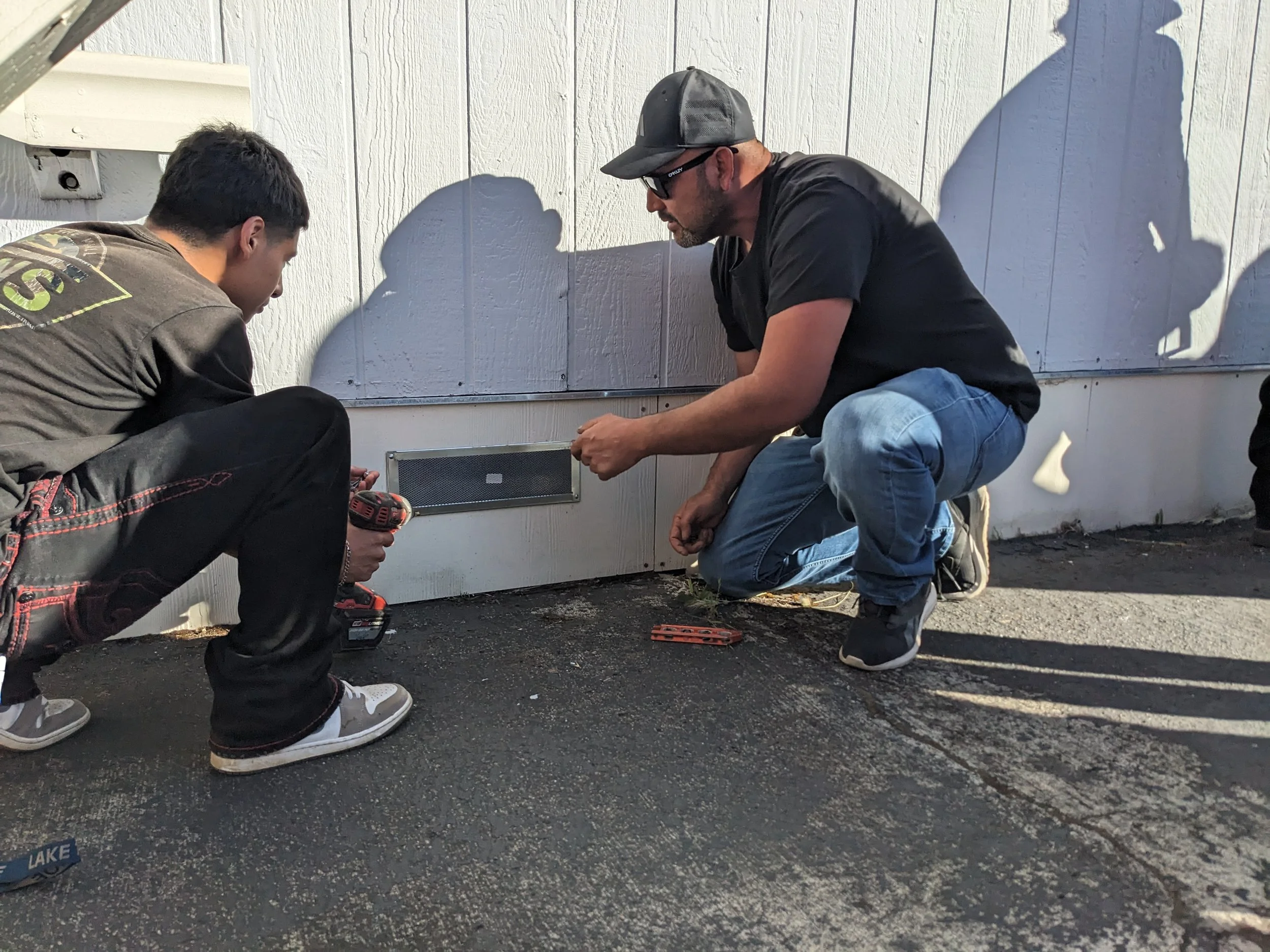
Sergio Olivares Zuniga shows a young student how to use a power drill on a vent screen
One Thursday evening, after their regular school day, two dozen high school seniors spent another few hours learning how to build homes that will stand up to fire. These teens have been selected to participate in the Mendocino County North Bay Construction Corps (NBCC), which is the workforce development program for the North Coast Builders’ Exchange (NCBE). Every Saturday and most Thursday nights for three months, two cohorts of students, one on the coast and one inland, get trained in the basics of various construction trades. There is some classroom work, but the best part of the training is hands-on experience with experts in the field.
This year, the inland cohort came to the Mendocino County Office of Education (MCOE) campus in Talmage to learn about how to make fire safety improvements on buildings. Students gathered with varying degrees of bashfulness as Sergio Olivares Zuniga, of OBM Construction in Clearlake, handed out power drills and bits of advice. They started by swapping out vent covers for finer-mesh screens that will keep out embers. Then they removed a flammable awning and replaced it with a sturdy metal one.
“We have to change the culture when it comes to home hardening in construction, meaning we gotta start young,” said Natalie Spackman, Workforce Development Manager for the NCBE. “When it becomes the norm, that’s part of it.”
Eric Crawford, Coordinator for the NBCC in Mendocino County, agrees. That’s why he had a crowd of teenagers running power tools after hours on a campus that’s normally full of indoor office workers. “This is the first year that we’ve done home hardening as part of the program,” he said, to the tune of whining power drills. “But changing out screens into finer meshes and putting more sturdy building materials on the side is super important, as we all learned eight years ago. Some of the materials are more expensive than conventional materials, but in the long run, you’re protecting your investment, and making yourself safer.”
The program has a history of putting students to work on timely projects. The first class built an outbuilding in Redwood Valley in 2018, just a few months after the 2017 Redwood Complex fire. Now that so much of California has been razed by fire, home retrofits are more important than ever. The state has started giving out grants to organizations that can get the work done in fire-prone areas, and construction codes are changing fast. Deanna Fernweh, Program Manager for Lake County’s home hardening program through North Coast Opportunities (NCO), knows part of this means expanding the workforce. In 2024, Lake County was one of six in the state to receive a grant from the California Wildfire Mitigation Program, a joint effort of Cal OES and CAL FIRE to fund home hardening in low to moderate-income areas. In the last two years, NCO has worked with dozens of contractors, including Olivares, to harden 62 homes, start building others, and conduct more than 100 fire resiliency assessments.
But the work is just beginning. “We have approximately four to five million homes throughout the state of California that are not up to code,” said Fernweh. “So any home that was built before 2008, we want to look at those vents. We want to make sure we have gutter covers and siding, and all of those great retrofits that protect your home against ember intrusion.” Wind-driven embers are fast-moving sparks that can sneak into the corners of a home and simmer for a while, unnoticed, before they develop into full-fledged flames. Creating an ember-resistant environment is the first — and best — line of defense against fire.
While it is always possible to spend too much money on construction, Fernweh emphasized that sometimes, a little bit goes a long way. “The vents we are using today are about $8 each,” she said. “So you can do a lot of these retrofits little by little, especially if you’re one of those weekend warriors. In fact, a majority of our retrofits, as far as cleaning out your zone zero, moving that BBQ, getting that flammable furniture away from your home, you can do for free.”
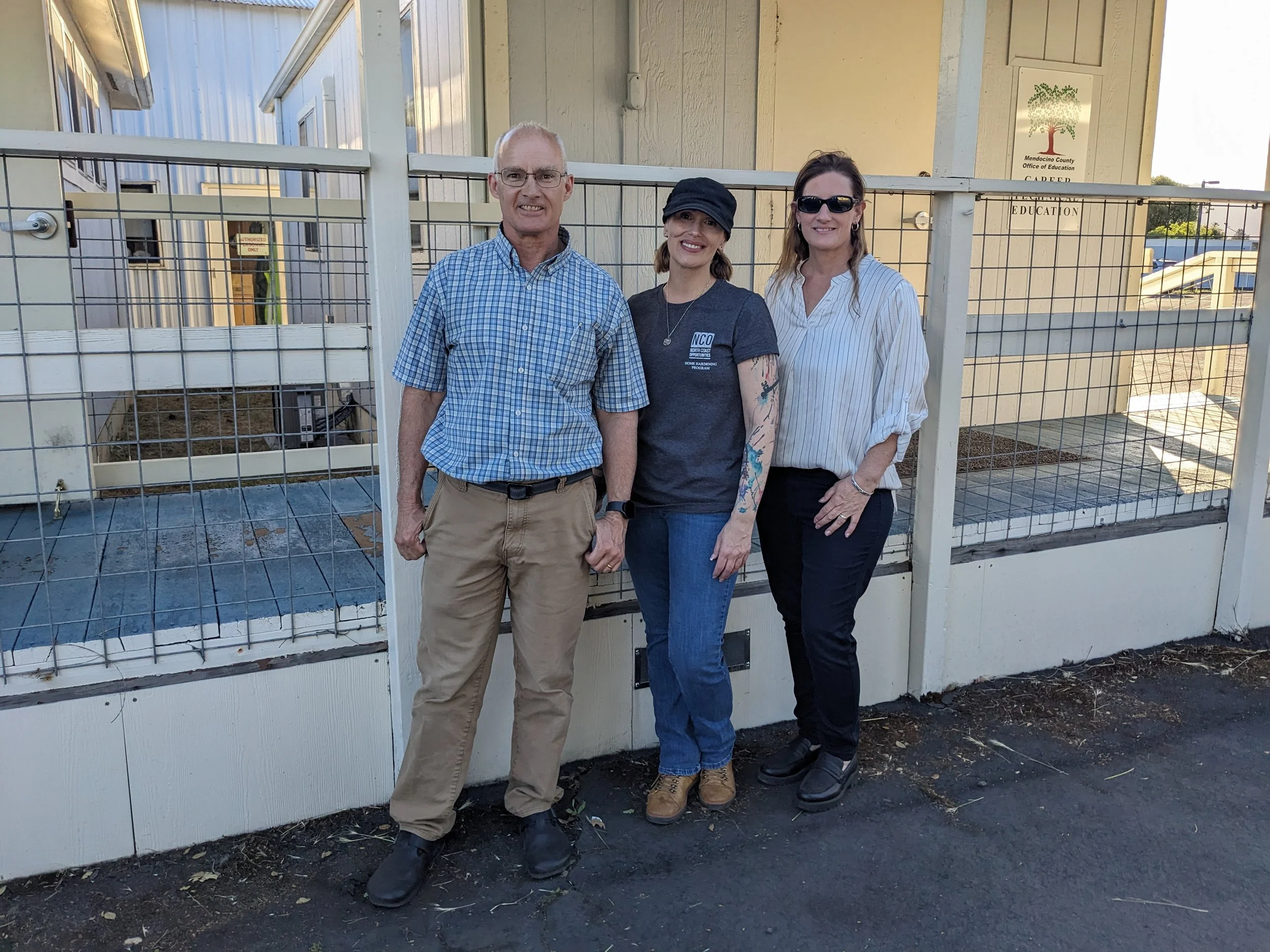
Eric Crawford Deanna Fernweh and Natalie Spackman at MCOE
Though self-sufficiency also goes a long way, Spackman, of the NCBE, is counting on the growing need for well-trained professionals. “Home hardening is a huge part of the construction industry,” she said frankly. As for young people considering a career in the trades, “They’re going to see all of this stuff on a jobsite, and the sooner that they’re exposed to it, I think it’s going to benefit all of them tremendously.” She didn’t hesitate to brag about the students either, noting that, on their way to the jobsite after a 45-minute presentation, “They were pointing out all of the different things that they had just learned. If they’re able to do that for their future boss or employer, and say hey, I see this issue over here, it’s going to benefit everybody.”
Whether it’s seasoned professionals on the job or homeowners doing a few touchups on the weekend, Fernweh agreed that fire resiliency needs to become the new norm. “I just ask homeowners to look at your home differently,” she urged. “Just walk around and look at any of the holes and crevices where embers can intrude. When your home is hardened, your neighbor is safer. It really takes a whole community to make a resilient community.”
For more information about how you can harden your home and take other measures to protect your property from wildfire, visit firesafemendocino.org.