

How to have a great time preparing for an evacuation
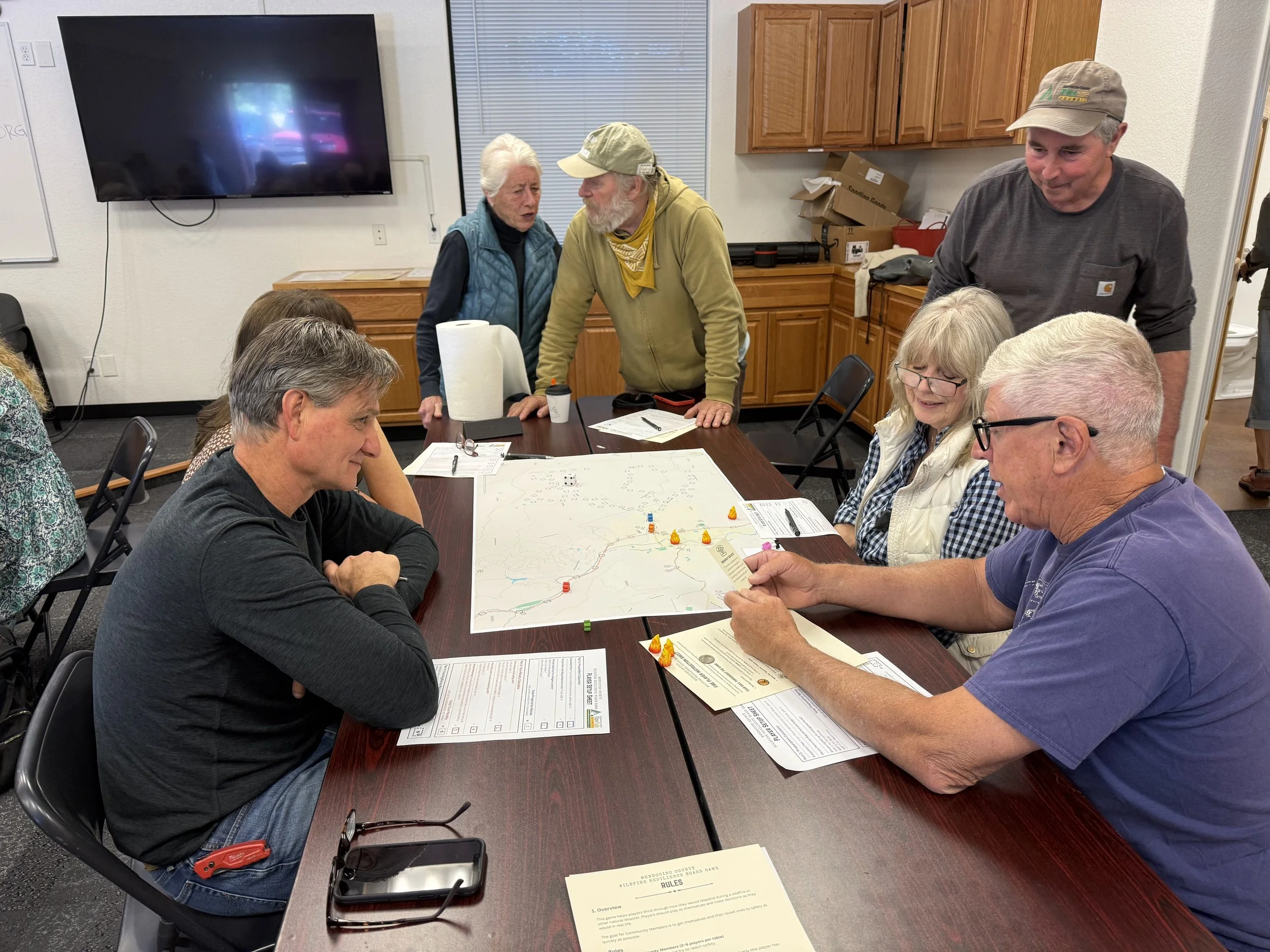
Sometimes, preparing to survive a life-or-death emergency is just good, lighthearted fun with the neighbors. That was the case one Sunday morning at the Hopland firehouse, where over thirty members of the Feliz Creek & Road 110 Firewise Community got together to play an evacuation board game.
The board was a large map of the Feliz Creek area, complete with road names and information about evacuation zones. Players established their starting positions by filling out a worksheet about their current level of fire preparedness — in real life. The game uses real-life information, mixed with hypothetical but realistic situations, to help people assess what obstacles might arise and how to be prepared if they had to flee their homes. At Mendocino County Fire Safe Council Executive Director Scott Cratty’s table, several players started with negative points, because they had not prepared in advance by having a written evacuation plan or a “Go-bag.”
When reviewing their startup assessments, Cratty told the players, “These are things that will give you a head start or be a hindrance. On the hindrance side, some of them are things you can’t control, like the number of pets you have or number of people in your household. If you’ve got a bunch of pets that you’re going to have to evacuate, you want to start early and get them ready to go. Get their food gathered up, get the horses in the trailer. Those are all things that are going to make your evacuation process take longer, which means you need to do a better job being alert and ready and starting sooner.” He took the opportunity to encourage everyone to sign up for multiple alerts, through Nixle, Watch Duty, and the county’s emergency services. If one alert system fails, another one may be functioning the way it should.
Once players knew how far ahead or behind they were, they rolled a die to see how many steps they could advance towards safety. But of course it wasn’t that simple. They also had to draw ‘chance cards,’ which presented obstacles like downed trees, new spot fires, or not having needed medications in their to Go-Bag. Maria Esser, the Grizzly Corps fellow with the Mendocino County Fire Safe Council, described a chance card that sounds like a problem in an ethics class. “If you don’t have the phone number or contact information of your neighbor written down somewhere or memorized, you have to go warn them on foot about the fire and you end up skipping a turn if you do choose to warn them, because in real life, that takes time.” Another moral issue was a little less fraught. “There’s one that does a little bit of light public shaming,” Esser revealed. “If anyone at the table has a wooden fence connected to their house, then that person gets two moves knocked off of their roll.”
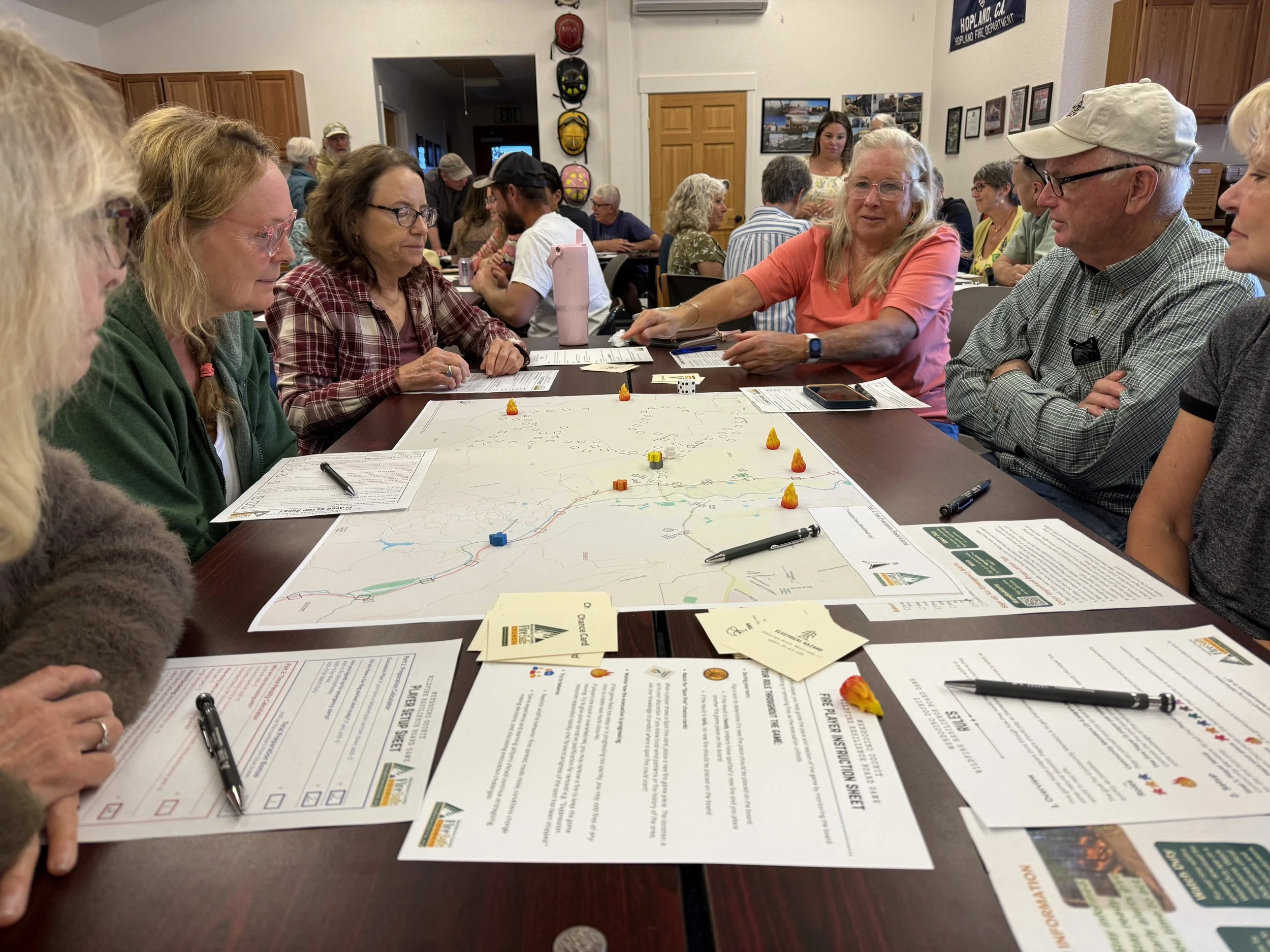
The game, Mendocino County Wildfire Resilience, is a local adaptation of a game that debuted in Marin County in 2024. It was created by a UC Davis team called Prototyping Resilience, led by Associate Professor Tom Maiorana. The project was funded in part by grants from the National Science Foundation. It’s designed to create a fun, low-stakes opportunity to prepare for a situation where people are often too terrified to think clearly. At Hopland, it worked. Neighbors discussed an especially dangerous spot in the road where trees encroach on the already narrow thoroughfare, and they updated one another on signage in a confusing maze of roads between Hopland and McNab Ranch. They knew which way the wind blows where, and which redundantly named road runs past whose property.
Bernadette Byrne, who is part of the Feliz Creek & Road 110 Firewise Community, had a positive review of the game, saying, “It was surprisingly impactful because it was very thought-provoking. The chance cards brought up lots of obstacles, issues, circumstances that you might not be thinking about, and then you’re like, oh, right. Do I have that radio? Do I have the batteries nearby?” At her table, a downed tree presented an impossible choice. “Change direction, if you’re fortunate enough to have multiple directions to change to,” she reflected. “In communities such as ours, there’s one egress and one ingress, and so you hope you can move the right way, because there’s not a lot of options.”
Byrne was proud of her community for showing up and being so willing to share information. “We have had that for all of our meetings,” she reported. “We know each other, and really would work together to support each other in the case of an emergency, and how we would evacuate.”
The objective, in the fun board game with friends and neighbors, is not that different from helping one another stay alive. Esser made the point succinctly, saying, “The goal is to get to safety. But the overarching goal is to think about possible roadblocks that you might come across in the case of a real evacuation.”
For more information about how you can prepare for a successful evacuation, or get involved with your neighborhood Fire Safe Council or Firewise Community, visit firesafemendocino.org.
