

Prescribed Fire Association Leveling Up, with Help from Mendocino County Fire Safe Council
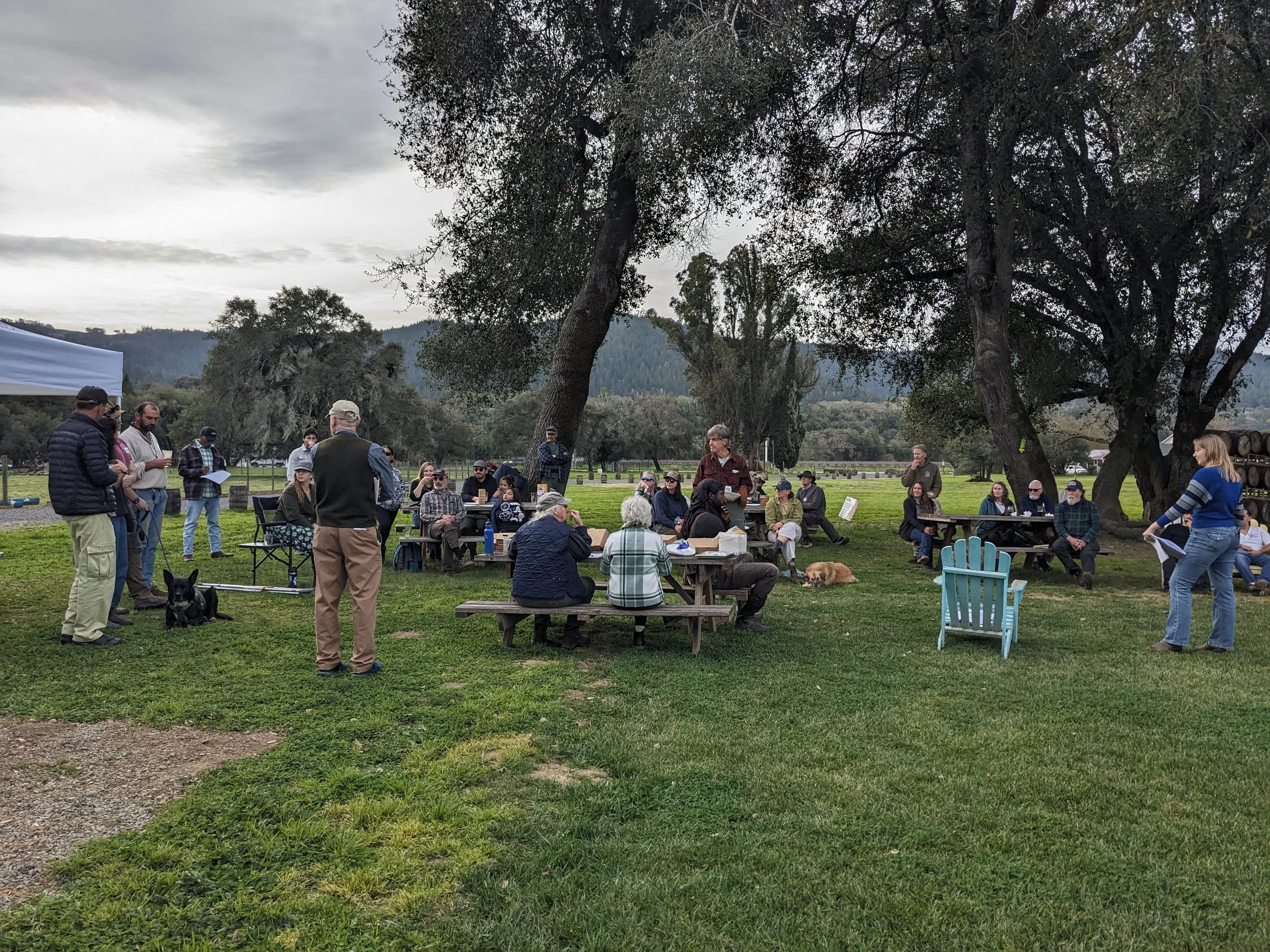
It turns out prescribed fire and pizza are a popular combination – more than 40 people came to the Anderson Valley Brewing Company on a balmy California winter day, for pizza and an informational event about the Mendocino County Prescribed Burn Association (MCPBA).
MCPBA Steering Committee members took questions from landowners, land managers and curious residents from microclimates all over the county. Visitors from Laytonville were interested in the confluence of fire, forest health and the Eel River, while coastal residents asked about native plants.
This meeting was the first in-person event for the organization since the pandemic. Also, for the first time, MCPBA has a paid staff person who can focus on the logistics of getting more controlled fire on the ground. Emily Lord is the Beneficial Fire and Education Coordinator for the Mendocino County Fire Safe Council (MCFSC), which hired her in part to increase intentional burns in the county.
“A lot of what I’ve been able to provide,” Emily said, “is logistical support… In the upcoming year, we’re looking to do more events like this, engaging with community members and understanding the needs for fire in their area.” Glancing at the results from the survey she handed out before the event, she saw that, in addition to more burning, attendees had a strong interest in more opportunities to learn about fire, like workshops and lecture series.
Jennifer Smallwood drove to Anderson Valley from Point Arena to find out if prescribed burns are a fit for her community. The tiny coastal city is much cooler than inland Mendocino, but she described a set of conditions that make it very clear why residents there are starting a Firewise Community. Point Arena borders national forest land, she explained, “and we’re really interested in all their dead and dying trees, and what they're going to do about it, and what we can do about it together.
“Also, the geography of Point Arena (has) draws and ways that the ocean air comes into these different little crevices and valleys.” This means that wind could pick up speed and tear through town, igniting dried vegetation in a scenario that has become all too familiar in communities with only one way in and one way out. “There are so many ifs,” Smallwood concluded. “If that happened, we’d be in a world of hurt. So yeah, we really need to clean the place up and have more defensible space – which is why we’re becoming a Firewise Community.”
Dr. Michael Jones, the UC Extension Forester for Mendocino County and an MCFSC board member, is one of the founding members of the MCPBA and its current chair. He says the entire county is adapted to and dependent on fire – “what changes is the frequency of that fire,” he said. If you’re on the coast, fire is an important part of the ecosystem; maybe it’s just not as frequent. In Ukiah, fire might be an important disturbance every ten years, but on the coast maybe it’s every fifty years. There’s still an important relationship with fire, but with different scales and different impacts.”
There are also different reasons to burn. Many landowners focus on burning dried vegetation to protect their homes and property, but Jones also urges people to incorporate ecological management objectives into their burns. This can complicate a burn plan, but the objectives don’t have to be at cross-purposes.
“For example,” Jones explained, “the best time to burn range or grasslands is in spring, to manage for invasives. But that also happens to be the time of year that nesting birds, especially those that like grasses and shrubs, have active broods or are starting to build nests in that space. You don’t want to destroy that habitat! So you might think, can I burn before that nesting window? Can I burn after that window? Or maybe you decide not to burn this time of year.”
Jones and other experts who volunteer with the MCPBA are happy to help design burn plans and provide volunteer labor when the day arrives. They have longstanding lines of communication with fire departments, CAL FIRE, and air-quality management officials.
Olivia Para is an MCPBA steering committee member who moved to Mendocino County with her young family shortly after the devastating fires of 2017 and 2018. “I was just afraid,” she remembered. She attended an event at UC’s Hopland Research and Extension Center, where Jones and other early MCPBA members were extolling the benefits of fire on the landscape – “on my timeline,” as steering committee member Kyle Farmer put it, “not accident’s timeline.”
Para was hooked. She took her toddler to a burn, and set a drip torch to grasslands as the child played with some toys the rancher had on hand for the grandkids. She’s not a burn boss, but her relationship with fire is based on respect, not fear. “I think it’s so valuable for people to just experience it,” she said. “I can feel, I can hear the intensity of fire. I’m never going to be the one advising people on how to do burns, but it’s given me enough confidence to understand my own home, and what I can do.” After she moved into town from the country, she used her knowledge of fire to inform the process of rebuilding the house at her new location.
“I would really encourage people to be involved with the PBA,” Para says, “not even because they have big tracts of land that they’re managing, but to better understand how to protect their own home, even if they live in town. It’s also fun, right? It’s just great people, even if it doesn’t involve fire. So much about fire is the prep work – learning how to use a chainsaw, and how to clear fuels. Maybe I want to burn over there, but if I don’t clear all this other stuff, I’m going to kill my beautiful oak that I want to save. So a lot of it is learning what you need to do before a fire.”
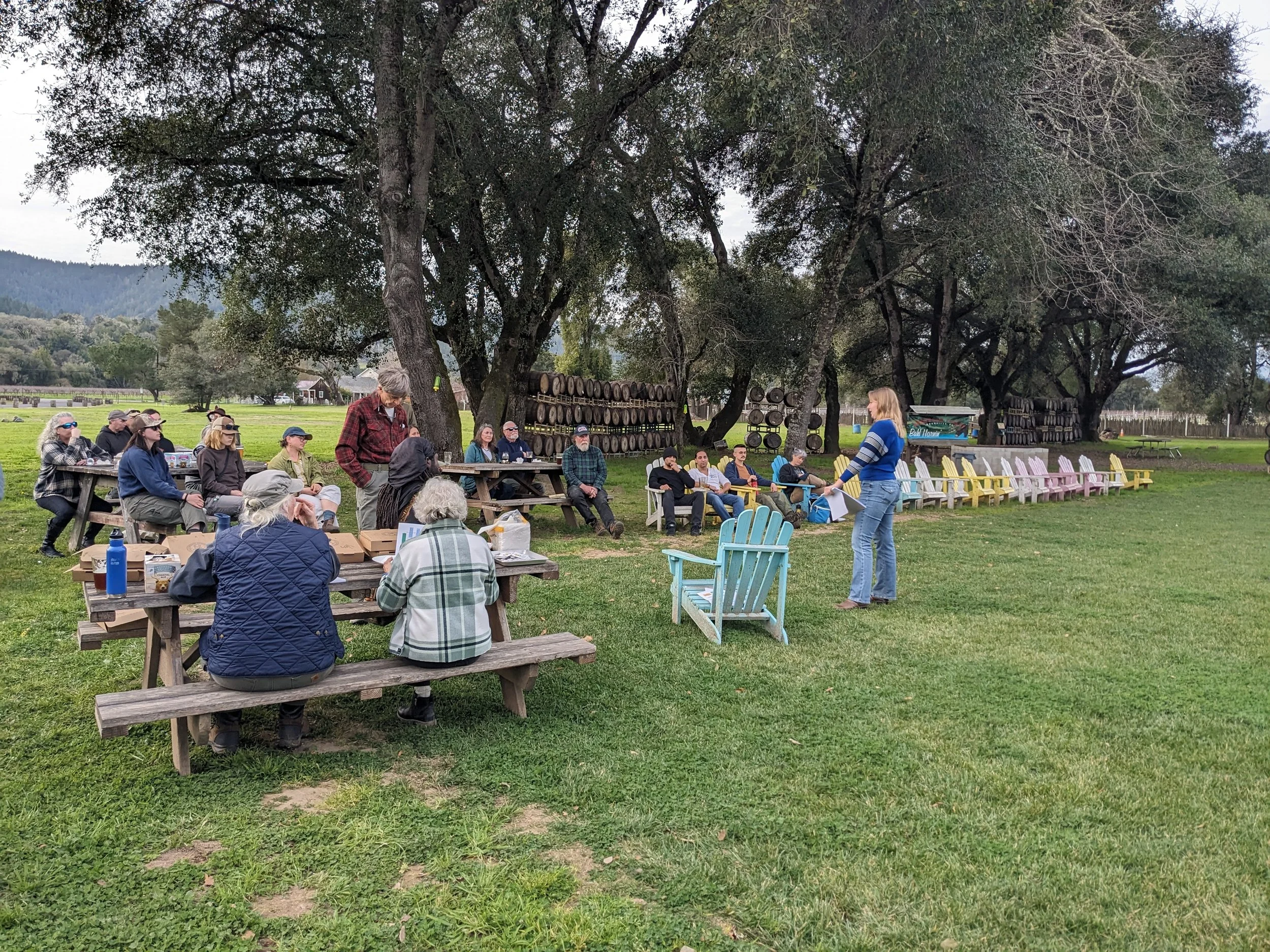
The social aspect is key. Lord says the PBA model is based on a tradition of “neighbors helping neighbors, where one person puts out a call for help; then everyone shows up, they eat a big meal together – and the expectation is that you will help your neighbor in return. That is what we try to embody, from the same grassroots perspective.” She’s hoping that, with more workshops, more organization, and more expertise, more people will call on the PBA for help with thoughtful burning.
“Email us at mendopba@gmail.com,” she invited. “We would love to work with anyone who’s interested in getting beneficial fire on the ground, and learning about fire in their neighborhood and their ecosystem. We hope to see you out on the fireline, or at one of our workshops or events.”
To find out how you can involved and learn more, you can also visit the MCPBA website at https://calpba.org/mendocino-pba.
