

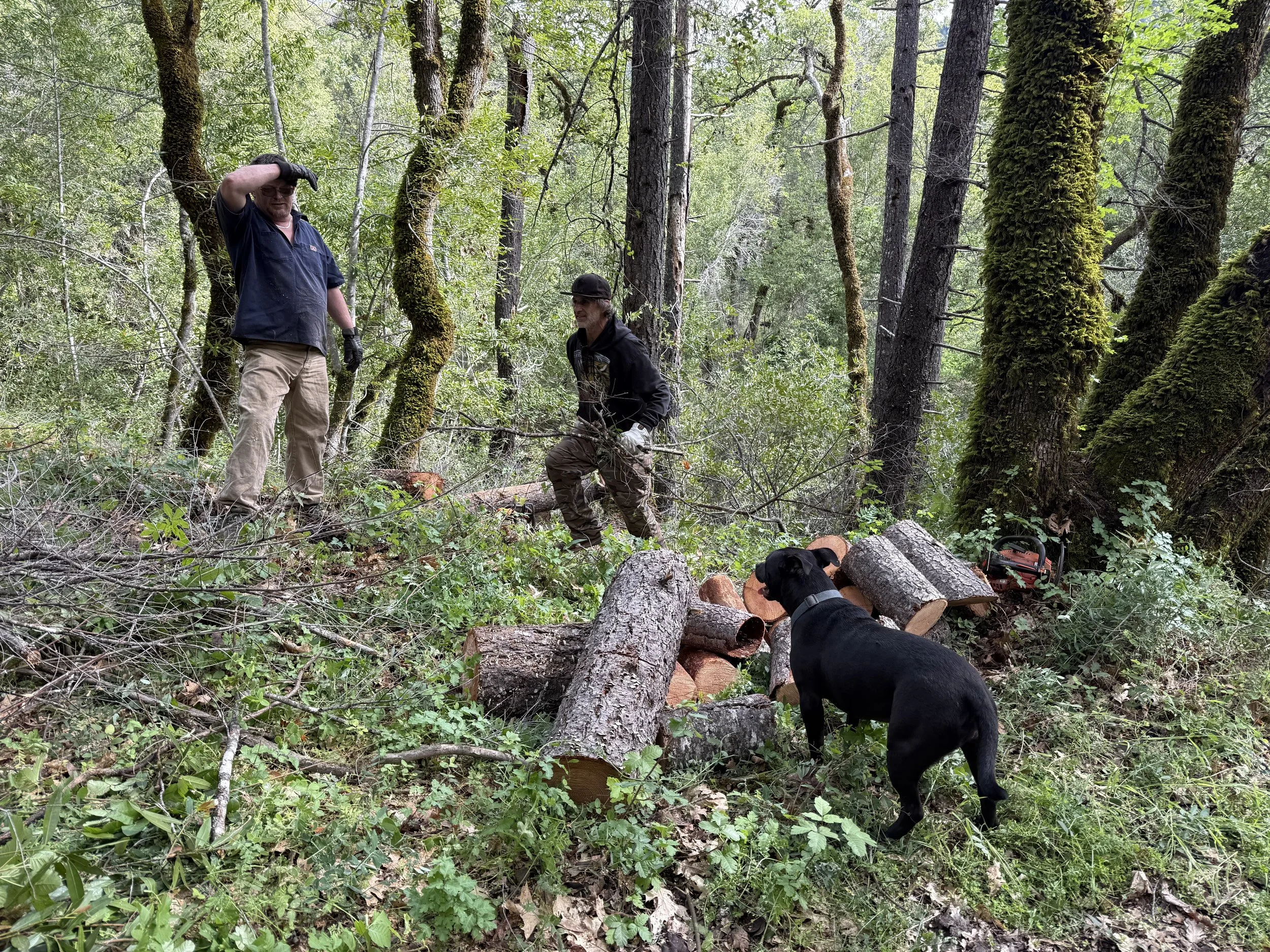
Nearly ten years after Tomki Road served as a major escape route from the Redwood Complex firestorm, a new Neighborhood Fire Safe Council is hard at work, clearing fuel from the roadside. “We’ve gotta make sure these escape routes are nice and open,” said Eric Patino, a member of the Mendocino County Fire Safe Council’s fuel-reduction crew. “We want the people and the community to be safe.” It was Saturday, April 14, and the crew was working alongside volunteers from the new Council.
The MCFSC is supporting neighborhood work parties with a grant from the California State Coastal Conservancy. That grant will cover roughly 75 community chipper days and 10 community work parties per year for three years. The grant started in February 2026, and the April 14 event was the second work party it funded.
The new Tomki Neighborhood Fire Safe Council isn’t wasting much time, either. The group was formed in August of 2025, shortly after a meeting with the MCFSC at the Abhayagiri Buddhist Monastery. The new Neighborhood Fire Safe Council encompasses about 1,000 acres, and includes both the Buddhist Monastery in the flatlands and the Mt. Tabor Holy Transfiguration Ukrainian Catholic Monastery further up the mountain, along with other residences in the area.
Some of Tomki Fire Safe Council’s members own hundreds of acres, while others have small quarter-acre parcels. “This is our first Community Work Party,” said Dennis Crean, one of the original members. “We’re trying to take advantage of all the opportunities available through the Fire Safe Council.”
The group also received Home Assessments (another free MCFSC program) to help residents learn how to harden their homes and make them more resilient against fire. Crean added, “we’ve applied for (MCFSC) Micro-Grants to help with the home-hardening after the assessments, and today we had the Community Work Party. So we’re trying to get a lot happening, and get our area cleaned up.”
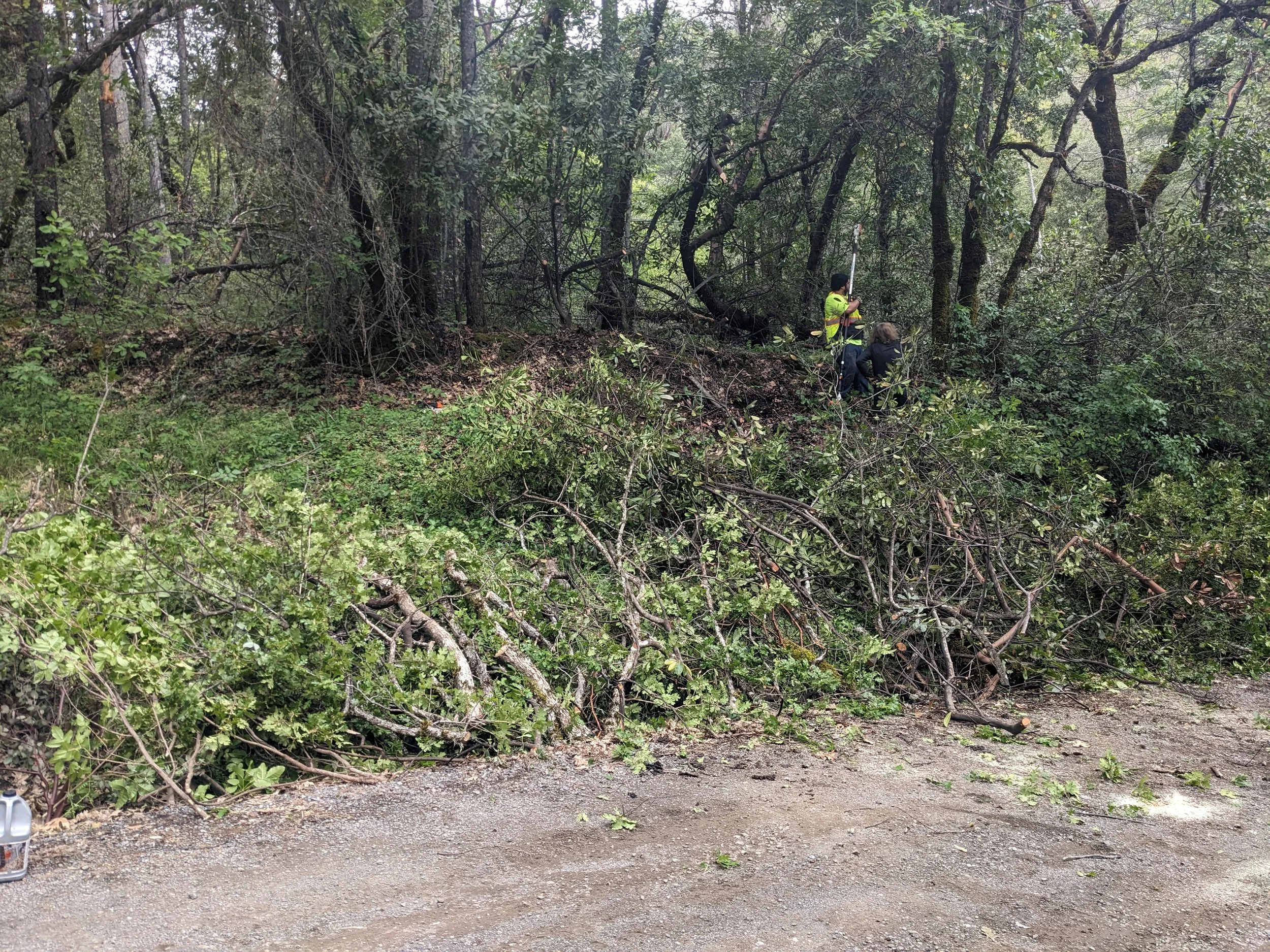
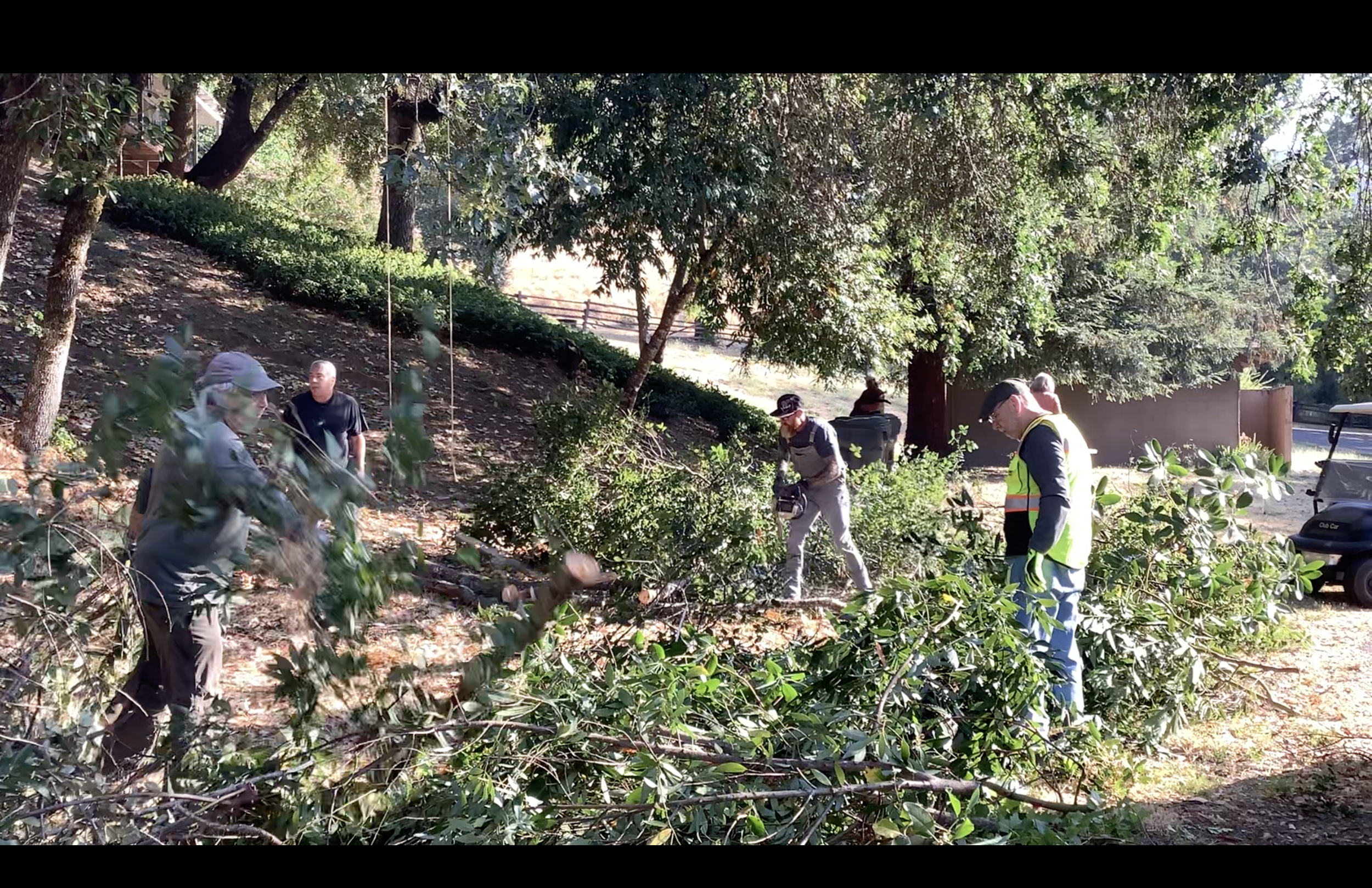
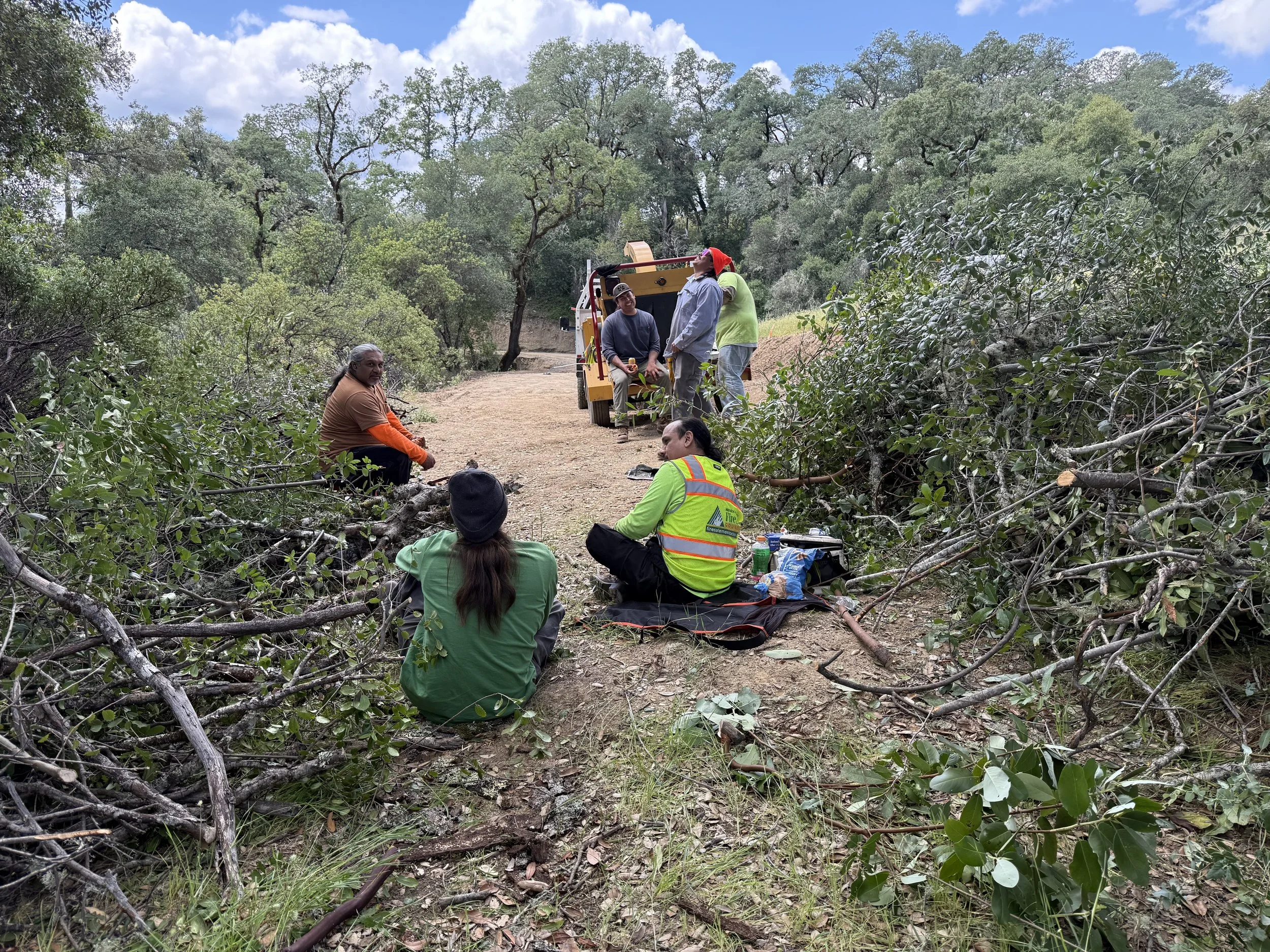
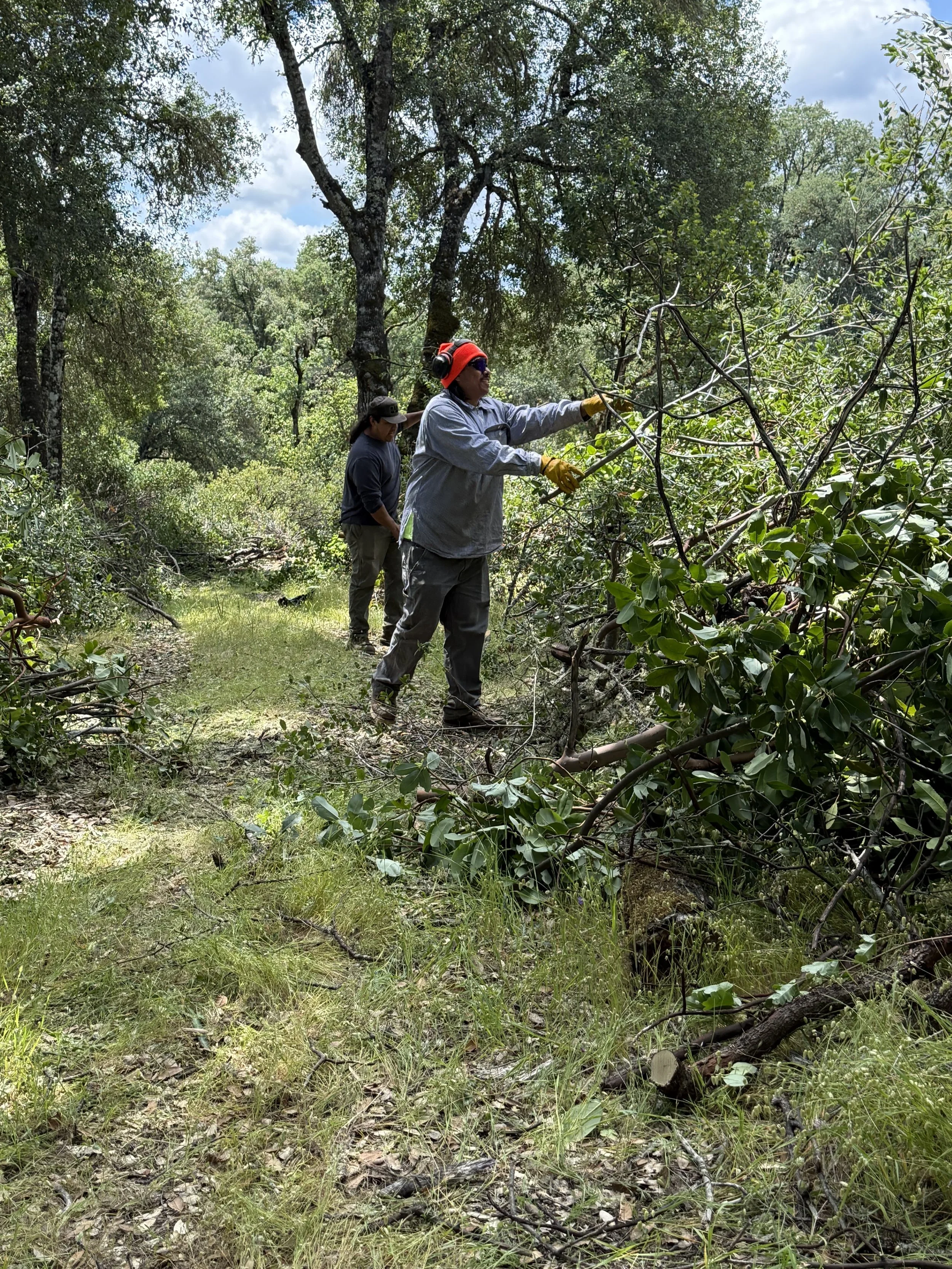
In order to get as much work done as possible during the one-day project, volunteers from the community along with MCFSC’s professional fuel-reduction crew focused on three points along the road that could potentially cause problems during an evacuation. The sky was overcast and the day was cool, but everyone worked up a sweat as they took down small-diameter trees and leafy shrubs that were encroaching on the narrow route. They stacked the wood in tidy piles for crew members to feed them into the chipper at the end of the day.
Steve Wilson, who has lived in the neighborhood since 1992, paused for a snack and a drink as he recalled the morning of October 8, 2017. At first, hours before dawn, he wasn’t perturbed when he discovered the power was out, “which happens a lot out here,” he explained. “I thought okay, whatever, and went back to bed. And then at 6:30 my son wakes up and says, hey, Dad, the power’s out. And the sky is kinda orange.”
His son went down the road to find out what was going on, and was not allowed to return. Finally, Wilson drove out to find cell service, and had the eerie experience of being alone in a disaster zone. “I couldn't find much until I went to the Buddhist monastery across the way, and there was nobody there. It was totally quiet – my new definition of quiet: a monastery that’s been evacuated.” He walked up the hill to a large Buddha statue. “As soon as I got next to the statue, my phone went, bing, bing, bing, and all my messages came in – people asking me, are you okay? And I was able to call my son and find out there was a major fire going on.”
Wilson believes fuel-reduction efforts are “a good idea,” and thinks that more education about how not to start fires in the first place would also be helpful. “You can go a long time without a fire happening, as long as you don’t start a fire,” he observed.
George Murray, a deacon at Mt. Tabor, also has vivid memories of the moment he learned of the fire. He was praying at 2:30 in the morning when he heard someone walking loudly towards him. “I was irritated, because monks don’t talk, and we keep silent and all that, but this older monk, named Brother Seraphim, said, ‘Deacon, Redwood Valley’s on fire.’ Initially, that sounded like an exaggeration to me,” he recalled.
Soon, though, he learned that it wasn’t. He remembers “driving down the road, seeing flowing metal coming from some bumper that was melting in the heat…It was really a stunning ordeal, and to see it built back like it is now is a beautiful thing. Not everybody remembers that, or thinks back on it.”
The aftermath of the fire was dramatic for a long time. Murray participates in extreme sports, including running and hiking in the mountains around the monastery. He recalled that on some days, “there would be no fire, and then the next day it would be coming out of the ground, then it would have gone under the ground to a different tree. It was burning down from within. You never knew what you were gonna find up there.
“One cool thing, though, about the guys that were doing the firefighting is that they used these long tubes that were abrasive in a way that you could hold on to them. They left them there, and they turned into rappel lines for us. I take people on extreme hikes out there now, and we talk about that, what was going on with the fire. Just a little good thing that came from a bad thing.”
Crean, who is “always looking for more people to get involved” with the Tomki Neighborhood Fire Safe Council, is well aware of the importance of the backwoods thoroughfare. “As a lot of people are probably aware, the fire came right across Tomki Road,” he recalled. “Some of the neighbors in our area were not able to get out that way, which is the normal way out. They drove heading that way, but that was right toward the fire – they got to where the fire had blocked the road and they had to turn around and come back. So then they had to go up north on Tomki Road, which turns into gravel, and I think it has seven creek crossings. Some people couldn’t even take their regular cars, and had to jump in with others into their pickup trucks that had higher clearance, and pop out on the north side into Willits. Egress is a real issue, and I’m hoping all this fire clearance along the road will make it safer.”
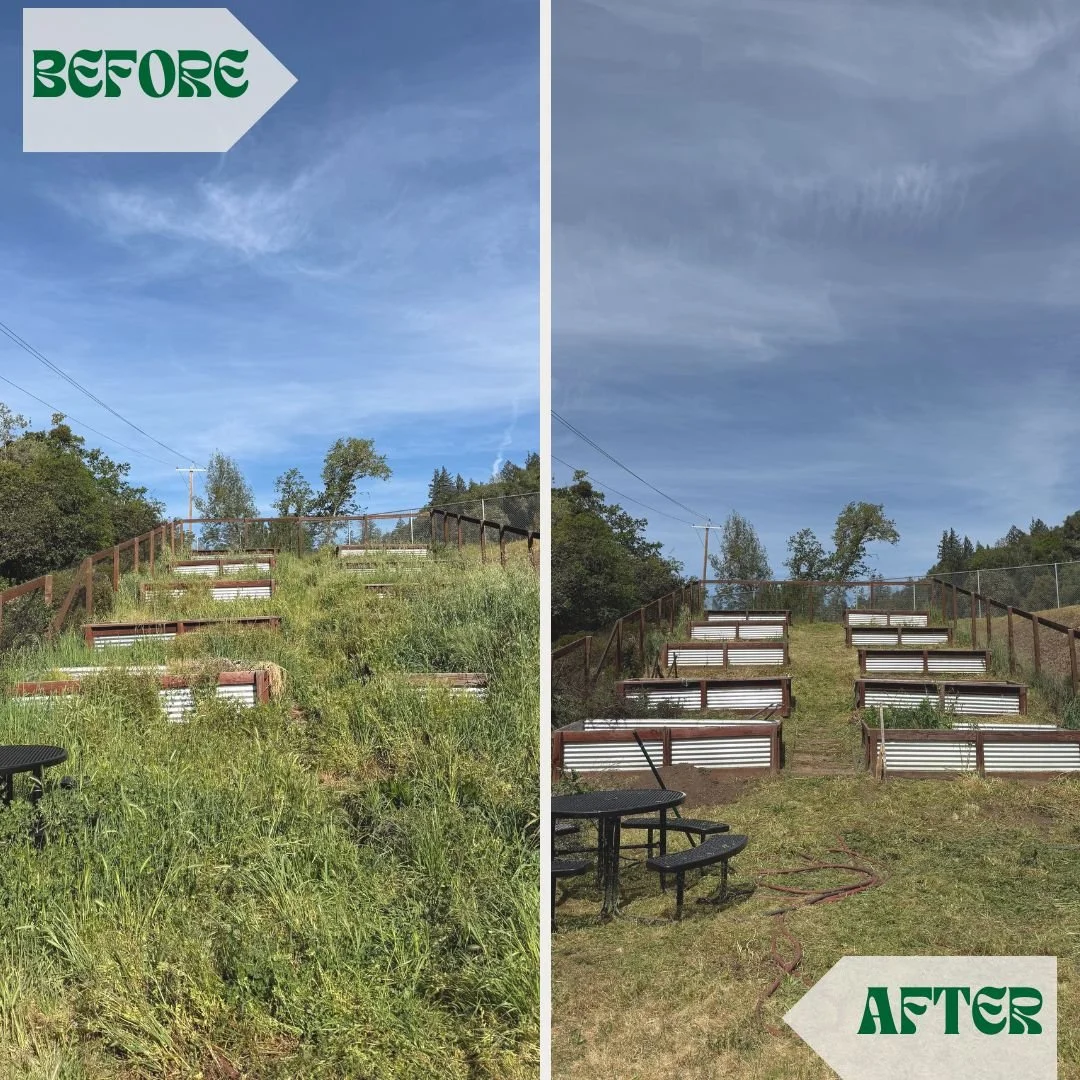
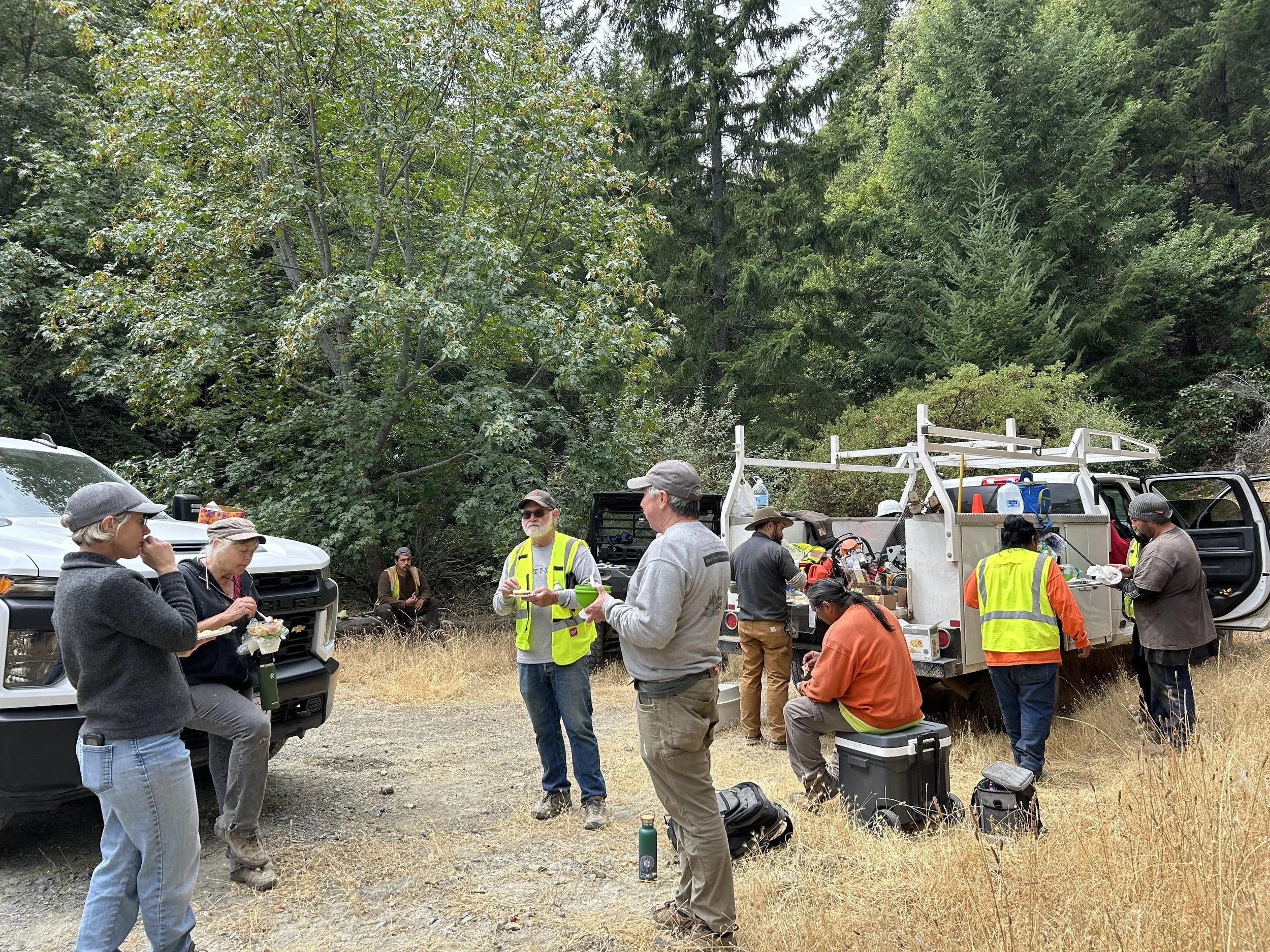
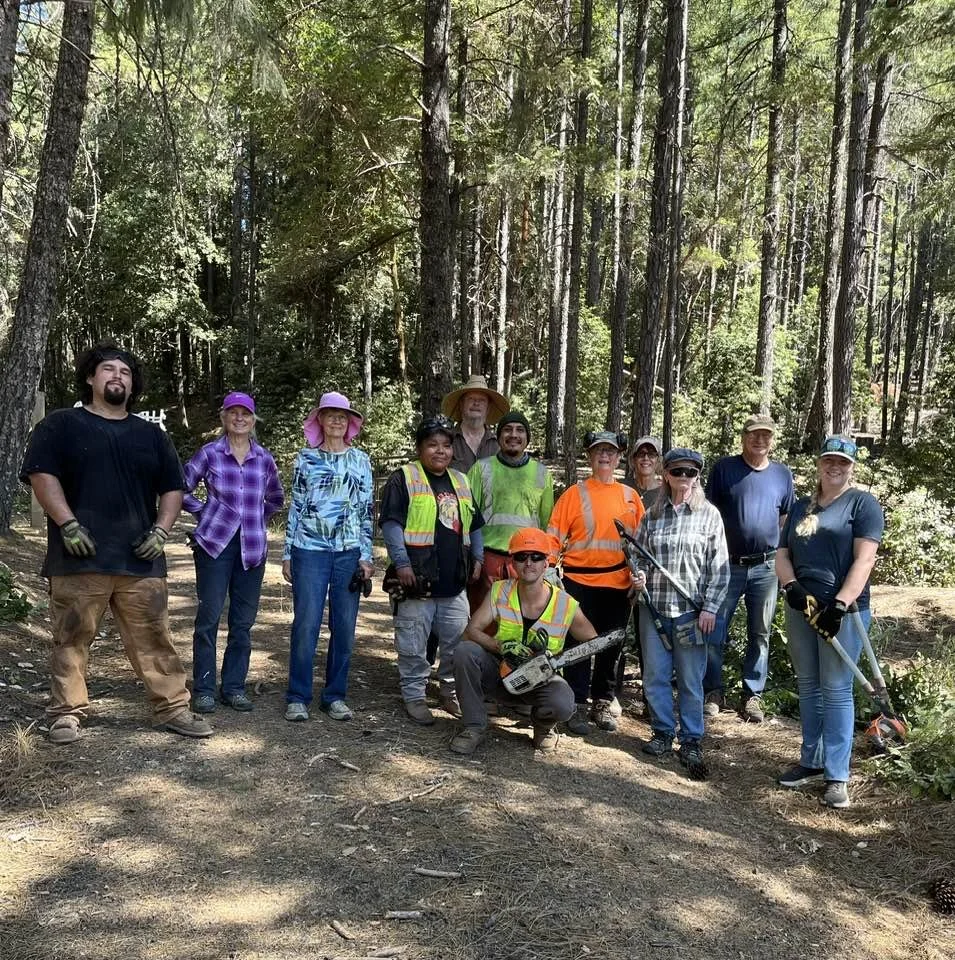
Community Work Party Photos Below

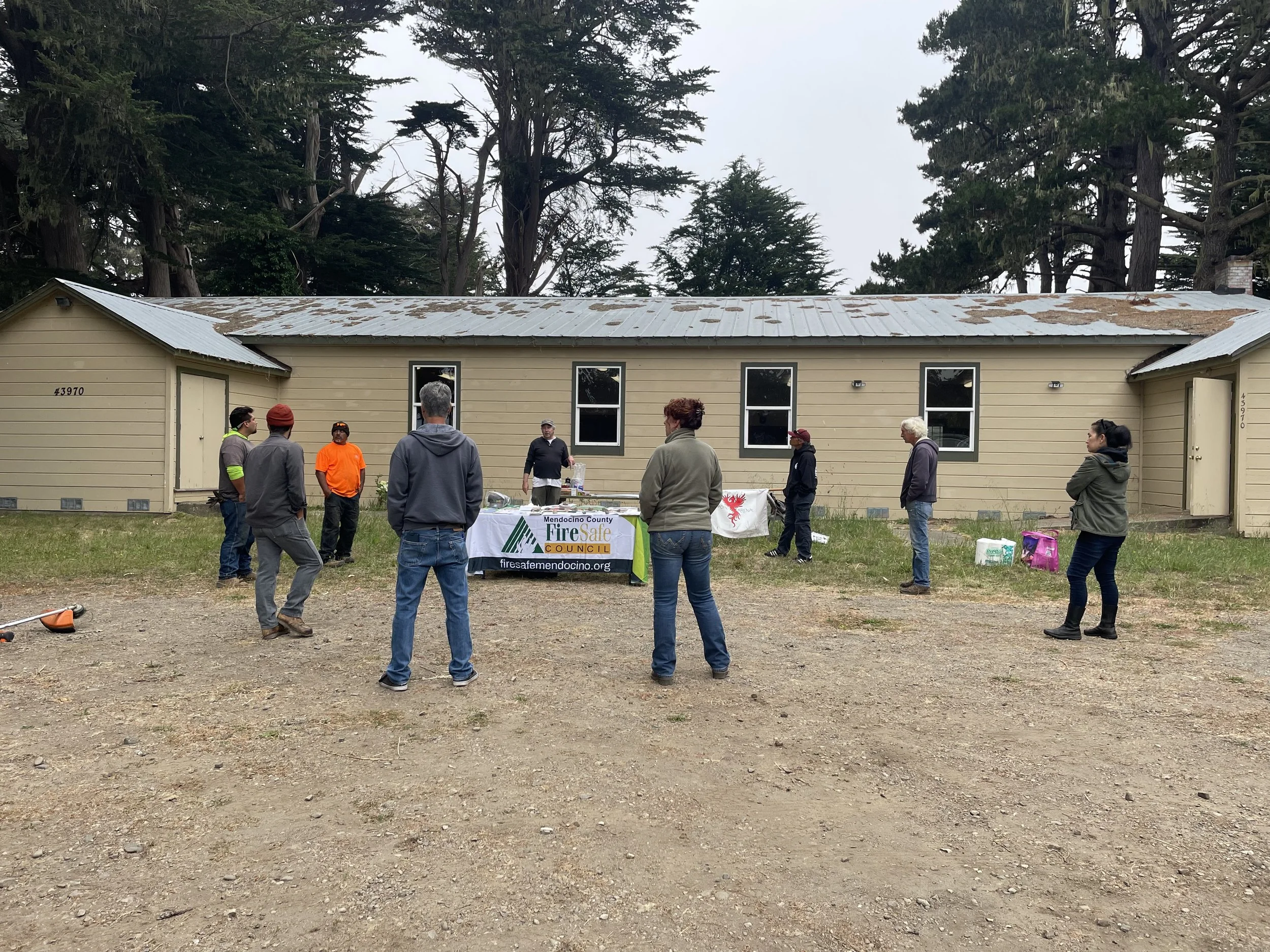
To learn more about how you can join a Neighborhood Fire Safe Council or start your own, with help from the MCFSC, visit https://www.firesafemendocino.org/nfsc.
